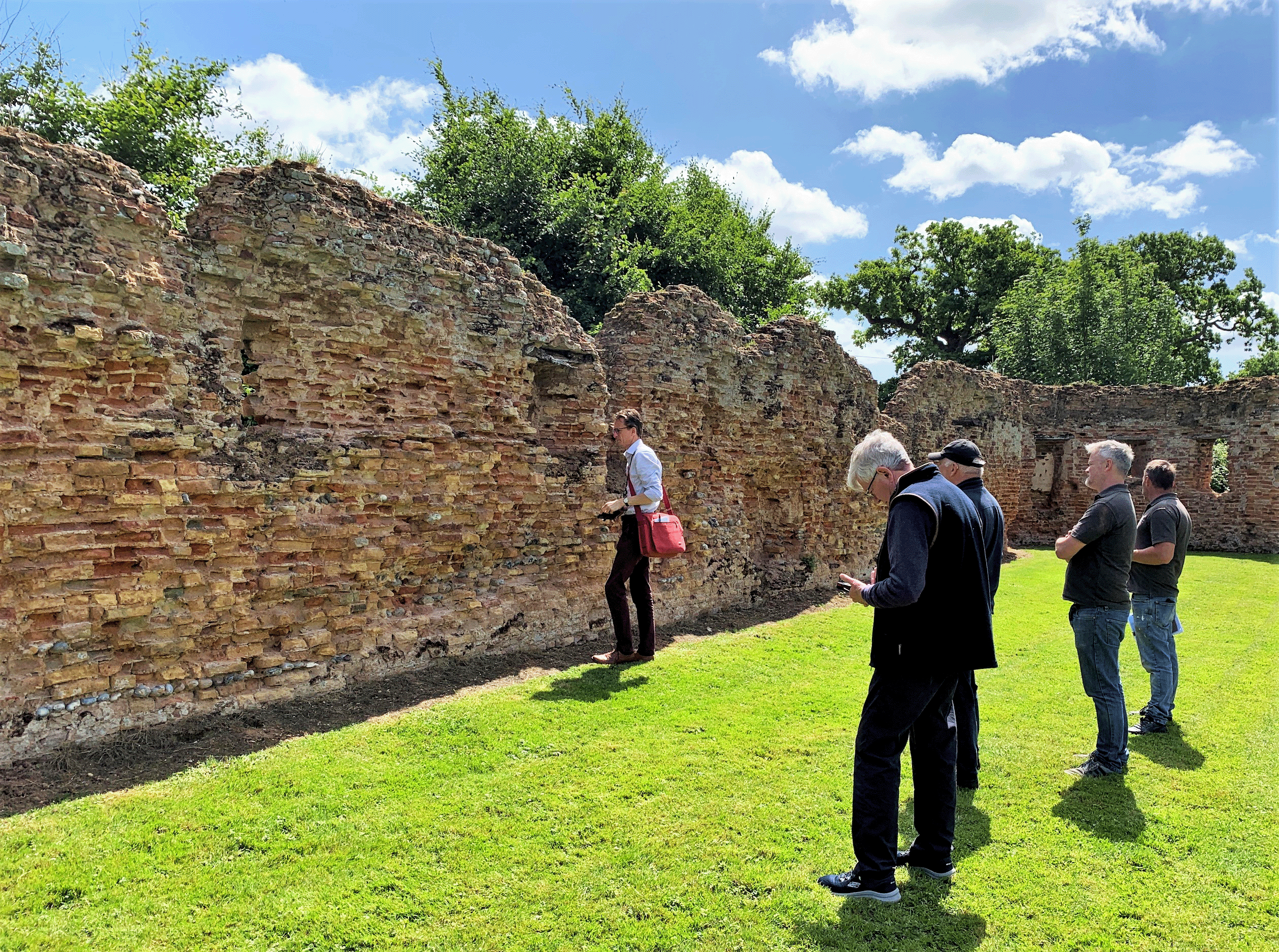
Gethin Harvey and Mark Hammond have recently undertaken an extremely interesting condition survey of the outer court walls at Caister Castle in Norfolk – by boat! The castle is thought to date to the late fourteenth or early fifteenth century, one of the first major moves from flint to brick in Norfolk, with 1.7 million bricks of pink to yellow hues delivered or made on site during Sir John Fastolph’s enlargement.

The amount of early material which survives is impressive, though much of it is in poor condition. The core of the wall is exposed and the structures which once adorned the outer court have long since been eroded, leaving internal faces subjected to the elements. In addition, the now ruinous walls have lost the water-shedding details which once protected them. Instead of being diverted away from the walls, rainwater runs across surfaces and penetrates the masonry, leading to:
- Weathering of soft brickwork: Traditional bricks and lime mortar are hydroscopic: they absorb moisture to varying extents during wet weather and later release it through evaporation. The mortar is typically seen as sacrificial, drawing the moisture through the joints rather than the bricks – thereby protecting them from associated frost/salt damage. This is desirable, as it is much easier to repoint a wall than replace the masonry. In this instance, on account of the sheer softness of the bricks, this has reversed and the bricks have experienced significant losses, recessing back from the original lime mortar – a phenomena often seen with the inappropriate use of cement!
- Frost damage: In cold conditions, freeze/thaw weathering will compound the above issue where absorbed water expands, causing bricks and mortar to spall.
- Vegetation growth: Cracks and shelves in the masonry allow water to collect and provide suitable conditions for vegetation growth to establish.
- Decay of structural supports: Saturation of the masonry will also accelerate the decay of embedded timber elements – namely the timber lintels, rotten in many places.
A need for intervention has arisen from the extent of this decay. The success of any repairs will depend on a careful balance of conservation – undertaking as little as is possible, but as much as is required. We are currently working to develop specifications towards a trial specification of repair so that this can be explored.